How to Increase CTR in SEO

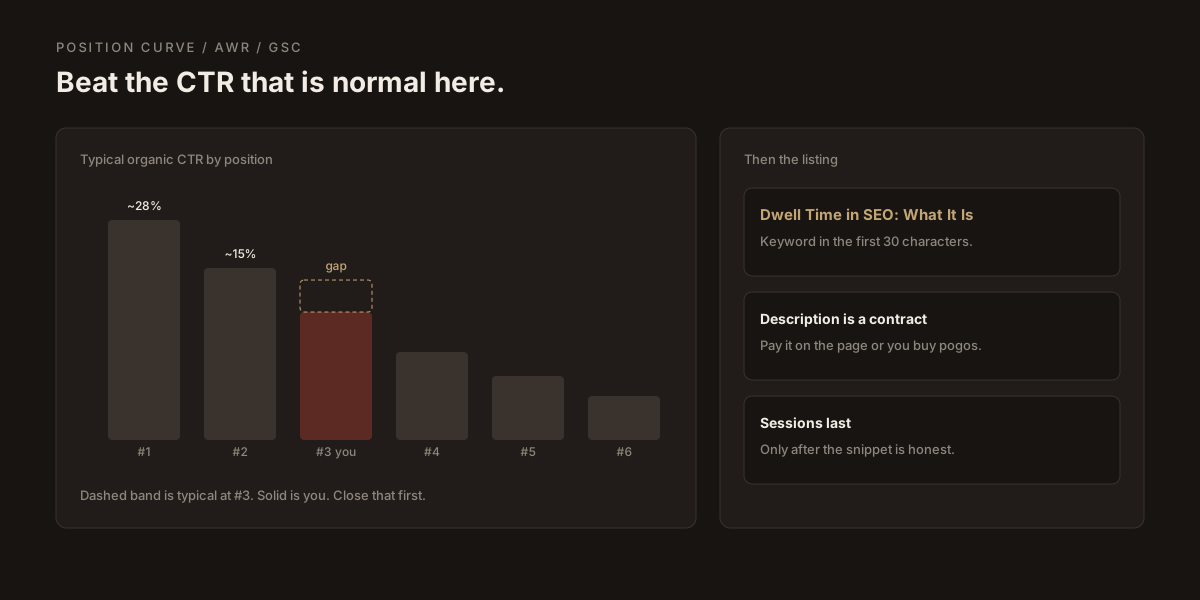
Google's NavBoost re-ranks using click history. Higher CTR is more traffic and a reason for that table to test you above your current slot.
Most teams still ship 2015 tactics: rewrite the title, wait, complain that a thinner page outranks them.
TL;DR
Increase CTR in SEO by beating the click rate that is normal for your current position. Titles, descriptions, snippets, schema, and honest emotion in the SERP do the listing work. Session quality is the visit after the click. Advanced Web Ranking publishes the position curve. Your Search Console file is the one that matters.
Why the re-ranker cares
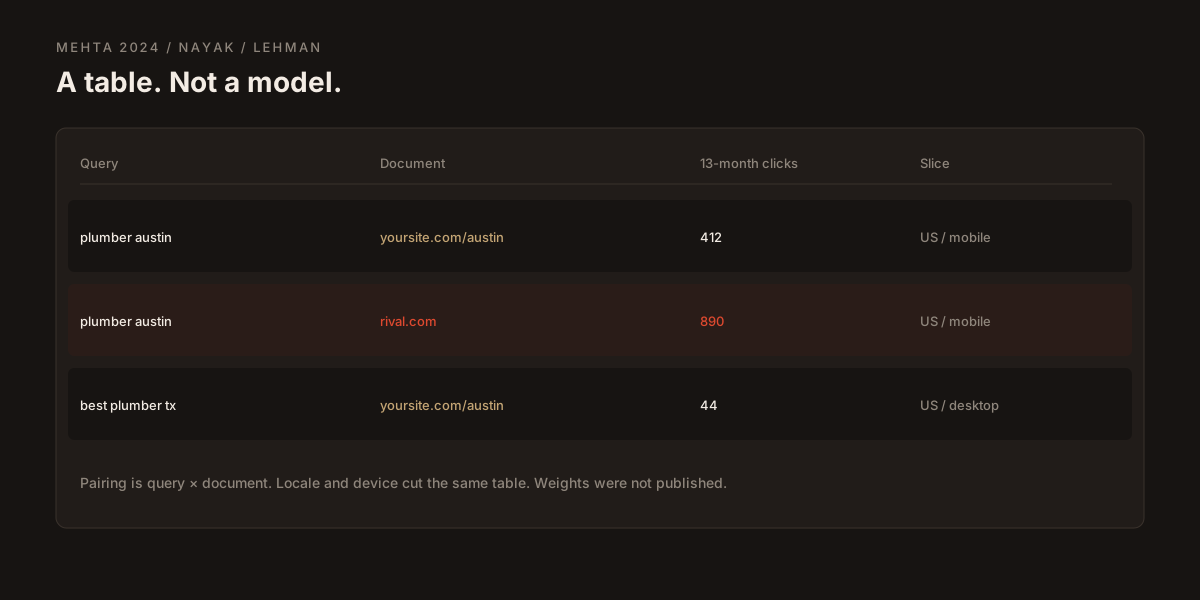
Before the leak, Googlers said engagement was not an organic ranking input. Judge Mehta's 2024 opinion says NavBoost pairs queries and documents by remembering clicks (Doc 1033, ¶96). Pandu Nayak placed it among the important signals (Doc 975).
If people consistently pick you over the URL above you, the system has a reason to swap. If they consistently skip you, it has a reason not to.
Position is not a plaque. You can "deserve" #5 on links and still get tested at #4 if CTR is fat for #5. You can sit at #1 with a dead listing and watch #2 get the trial.
That is a loop. Beat the average, earn impressions, earn more organic clicks. Miss the average, lose impressions, miss worse. The job is to exceed the CTR that is normal where you already sit. What CTR manipulation is is the name for doing the click half on purpose.
Benchmarks to beat
Advanced Web Ranking's organic CTR reports update by quarter, industry, and device. AI Overviews move the curve. There is no single 2026 "position 1 = 27.6%" law.
The useful fact is the drop-off, not a promise:
| Position | Working band (industry-typical) | Why it matters | |----------|----------------------------------|----------------| | 1 | High 20s to mid 30s when no AIO steals the click | Baseline. Double position 2 is common | | 2 | Mid teens | About 40% less traffic than 1 | | 3 | Low teens | Moving 4 to 3 is a real traffic event | | 4–5 | Mid to high single digits | Snippet and schema still move this | | 6–10 | Low single digits | Fix position before you obsess over CTR |
These bands are a sizing tool for a CTR gap, not a NavBoosted study. Pull your GSC query report. Compare each query to the band for its current position. The CTR calculator does the arithmetic.
1. Title tags that get chosen
Primary keyword, plus an emotional or proof hook, plus a specific. Odd numbers still outperform round ones in most SERP tests. Year stamps help on queries that go stale. Fake urgency is trash. "Updated for 2026" is a freshness cue only if the page is actually updated.
Weak: Local SEO Tips for Small Businesses Better: Local SEO: 7 Strategies That Increased Traffic 143%
Those percents are title examples, not NavBoosted case studies.
Put the keyword in the first 30 characters. Mobile truncates. "Dwell Time in SEO: What It Is" beats "The Complete Guide to Understanding Dwell Time for SEO." Keep 50 to 60 characters when you can. Change one title, watch GSC CTR for 2 to 4 weeks, keep the winner.
2. Meta descriptions that set a bet you can pay
Descriptions are not a direct ranking factor. They are CTR and they are a contract. Mismatch produces pogo-sticks.
Hook, what they get, a concrete benefit, a next step. Specific beats "improve significantly." Aim 150 to 160 characters. Google rewrites snippets a lot. Accurate copy still trains the rewriter. Clickbait trains a rewrite and a short click.
3. Featured snippets and rich results
A 40 to 60 word answer glued to an H2 that is the query is the paragraph pattern. A numbered list glued to a how-to H2 is the list pattern. A real HTML table is the comparison pattern.
FAQ schema, HowTo, review stars if you have real reviews, breadcrumbs. Review stars and FAQ move CTR the most for the effort. Validate in Rich Results Test before you ship broken JSON-LD.
If you hold snippet plus #1, combined CTR can sit well above a bare #1. That is the same keyword, more clicks.
NavBoosted is the session layer for when the listing is already honest: dwell, scroll, ZIP or city, a mix of satisfy / compare / soft miss, on a horizon, credits sized to the CTR gap. How the session plan works.
4. Mobile SERP is a different crop
Most searches are phones. Desktop shows more title and description. Mobile shows about 50 characters of title. Front-load. For mobile-heavy queries, write descriptions that still make sense at 120 to 130 characters. Search on a phone. Your laptop SERP is a lie.
5. Clicks you cause on purpose
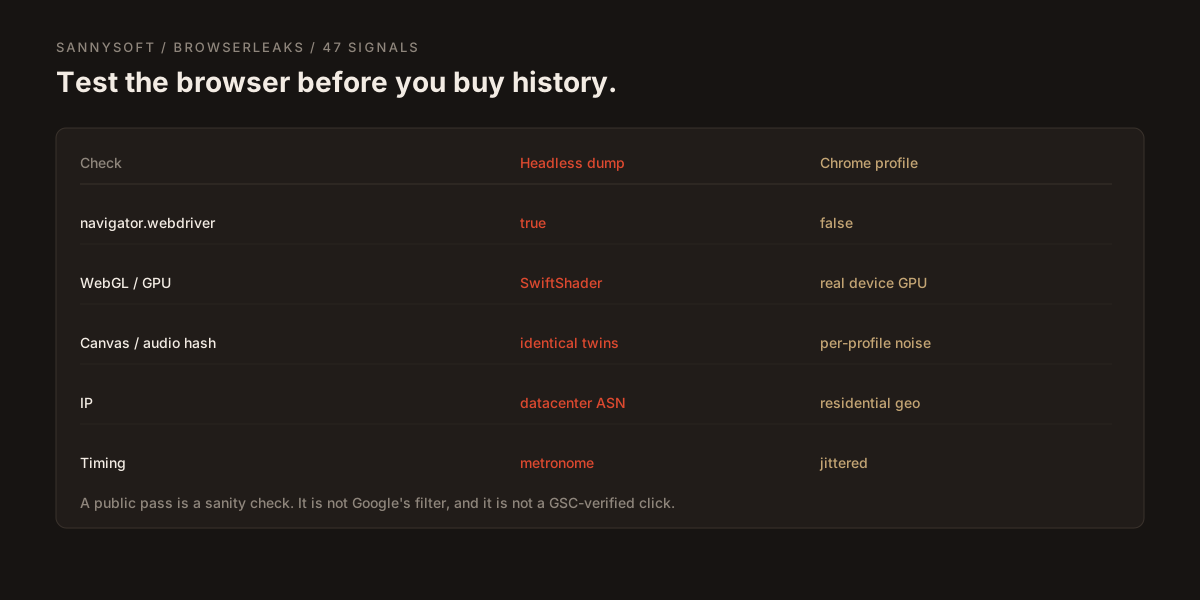
Everything above begs organic users to choose you. You can also run sessions that look like satisfied visits: fingerprints that survive a public test, residential IPs in the keyword's geo, dwell long enough that a return is not instant, messy timing, ZIP-level for local.
Datacenter Puppeteer and 5-second dwells are how you buy junk history. Test authenticity first. We do not claim Google cannot tell, or that GSC has verified the click.
Compounding is slow because the store is 13 months. A one-day dump does not write history. A 90-day ramp does.
Measure like a grown-up
GSC by query: below-average CTR first. By page: impressions without clicks. By position: vs the band above.
Opportunity in clicks per month is roughly impressions times typical CTR for that position, minus the clicks you already got. Sort that list. Fix the expensive misses first.
Change one thing at a time: titles two weeks, descriptions two weeks, schema two weeks, sessions two weeks. Otherwise you will never know what moved.
On-page snippet changes: 7 to 14 days after recrawl. Schema: 2 to 4 weeks. Sessions: give the 13-month series time to notice. Dwell time in SEO is the satisfaction half of that wait.
FAQ
How do you increase CTR in SEO?
Rewrite titles so the keyword and a specific sit in the first 30 characters. Write a meta description that the page can pay. Target featured snippets and rich results you qualify for. Then look at click quality after the visit. Measure in GSC by query, not by vibes.
What is a good organic CTR?
It depends on position, industry, device, and whether an AI Overview is on the SERP. Advanced Web Ranking publishes quarterly CTR by position. Position 1 takes a much larger share than 2. Use your GSC query report against that curve, not a universal percent.
Does CTR affect rankings?
NavBoost stores query-document click history and can re-rank with it. That is confirmed in the 2024 court record. Beating the CTR that is normal where you already sit is the only comparison that makes sense. A raw CTR number without position is noise.
How long do title tests take?
Give a title two to four weeks in GSC after recrawl. Change one thing at a time. Schema is slower. Sessions are slower still because the click store is a 13-month window.
Should you buy clicks to raise CTR?
Only after the listing is honest. A dump of identical 5-second hits writes junk history. A session plan sized to the CTR gap is the version that matches how the store is built. Test the browser first.
Start a 150-credit trial when the titles already tell the truth.
Emily Highsmith
SEO Research & Content
SEO researcher and content strategist specializing in search engine ranking factors, user engagement signals, and technical SEO. Passionate about demystifying how search algorithms work.
Continue Reading
Bot Detection Test: What SEO Campaigns Need to Check
A bot detection test is how you find out whether a CTR browser looks automated before you spend credits. Google can ignore junk traffic. Sannysoft, BrowserLeaks, PixelScan, and our 47-signal check are the public bar. Not Akamai's Bot Manager.
What Is Google NavBoost?
NavBoost is Google's query-document click table. The 2024 court record confirmed a 13-month window, locale and device slices, and Glue for other SERP blocks. The leak named fields. It did not publish weights.