NavBoost Revealed: What the Google API Leak Exposed About Click-Based Rankings

NavBoost Revealed: What the Google API Leak Exposed About Click-Based Rankings
The May 2024 leak was 2,500 pages of internal docs, not a Twitter rumor. NavBoost is named on the order of 84 times across five modules. Google VP Pandu Nayak told the DOJ it is one of the most important ranking signals they run.
If your playbook still treats CTR as "nice for traffic, irrelevant to rank," the docs disagree. Rankings move when Chrome users click, stay, leave, or pogo-stick, and that history sits in a 13-month window (18 months before 2017).
The stack, not a single score
NavBoost collects. Chrome-derived events: which URL was clicked, in what pattern, what happened after, where the user went next.
CRAPS (click and results prediction) turns that store into adjustments. The docs talk about click and impression signals handed to Craps from NavBoost.
Glue is the SERP-wide cousin: Knowledge Panels, maps, images, ads, other blocks. It folds clicks, hovers, scrolls, and swipes into one engagement-style metric so a carousel is not a separate universe from blue links.
Instant Glue is the short clock: about a 24-hour window, latency on the order of 10 minutes, for news and things that appear from nowhere. That is not your local-pack campaign. That is "something exploded on the internet today."
Click types the code actually named
goodClicks (float): long dwell, query looks resolved. The useful distinction in the notes is not "time on page" as Analytics defines it. It is whether the search journey stops on you instead of returning to the SERP.
badClicks (float): fast return, classic pogo-stick. Direct demotion fuel.
lastLongestClicks: they clicked you and did not come back to search. That is the target state.
clicks (float): volume. More events give NavBoost more to classify. Empty impressions with no clicks starve the model of evidence; a flood of 4-second hits poisons it.
impressions (float): how often the listing showed. Clicks over impressions is the attractiveness ratio. Seen constantly, never chosen: relevance problem, not a "CTR trick" problem.
Squashing: a normalization so one spike cannot own the 13-month series. Google's local-prominence patent language matches the idea. Unsquashed clicks are the ones that passed authenticity checks. Both flavors in the docs is why "we sent 10,000 clicks" is not a ranking sentence.
Unicorn clicks: named, poorly defined. Treat as outlier-quality events, not a metric you can report in a client deck.
Chrome is not "just analytics"
A page-quality-adjacent module exposes ChromeInTotal, a site-level Chrome view measure. Combined with the rest, Google can use URL, dwell, on-page interaction, next hop, and SERP return. Chrome user data feeds ranking decisions. That is the claim. Say it once.
Slices: place and device
Country and state/province click patterns are not one global score. California and New York can disagree. Mobile and desktop NavBoost are separate. A site that is fine on a monitor and miserable on a phone collects mobile badClicks even while desktop looks healthy.
When a slice has too little data, Google may smear a broader locale onto the query. That is an opening in thin local markets if the UX is actually good, not an excuse to spray national sessions at a ZIP-intent keyword.
Panda sits on the same table
Mike King's writeup of the leak (and the docs) puts NavBoost next to Panda's site-wide modifier M = IL / RQ: independent linking domains over reference queries. Fat link graph, rotten click graph: site-wide demotion. That pairing is a clean explanation for why some "Panda" recoveries took 13–18 months. You were waiting on the click store to roll.
Queries are bundled by meaning
NavBoost clusters intent, not only exact strings. gibberishScores fire on spun text, empty AI filler, nonsense. Google can score that even while the blog team says "we only look at content quality" in a conference talk.
Where it sits in the serving path
Mustang retrieves and scores. Twiddlers re-rank afterward. NavBoost, QualityBoost, FreshnessBoost are in that family. Perfect technical SEO that wins the first pass still loses if the click layer hates the URL.
Scoring happens at URL, subdomain, and root. A toxic subdomain can be boxed. A hero section does not automatically launder a neglected blog.
hostAge sandboxing for new hosts is in the attributes. Fresh domains get a probation so spam cannot buy day-one rank. Branded search and whatever engagement you can earn during that window matter more than a link blast nobody clicks.
What to change on Monday
Titles and descriptions are impression-to-click training data. Test them. Schema that you actually qualify for is SERP real estate, not a religion.
After the click, the page has to pay the snippet. Value above the fold, a scan path, media that is not stock sludge, internal links that are real next steps. You want lastLongestClick, not a bounce that Analytics calls "engaged" because a pixel fired.
Audit high-impression, low-engagement URLs for snippet lies, LCP disasters, intent mismatch, interstitials. Those are badClick factories.
Domain-level: more URLs in the topic you want authority in, fewer random verticals that dilute the click graph. Chrome-specific breakage belongs on the QA list because that is the browser feeding the store. CrUX is the public cousin of that obsession.
Plan in quarters, not in "we changed the H1 on Tuesday." Negative history decays on the 13-month clock. New sites should expect a data-poor start.
Mobile program and desktop program are not the same spreadsheet. Local markets where you can actually accumulate clicks will move faster than a national term where you are 0.2% of impressions.
If you use NavBoosted, the product is a session plan (satisfy / compare / soft miss, dwell, ZIP or city geo, horizon) sized to the CTR gap. Credits: Trial 150, Starter 400 for $49, Pro 2000 for $149, Agency 8000 for $399. Rank display is SearchAPI. No GSC-verified badge, no "undetectable" claim.
Emily Highsmith
SEO Research & Content
SEO researcher and content strategist specializing in search engine ranking factors, user engagement signals, and technical SEO. Passionate about demystifying how search algorithms work.
Continue Reading
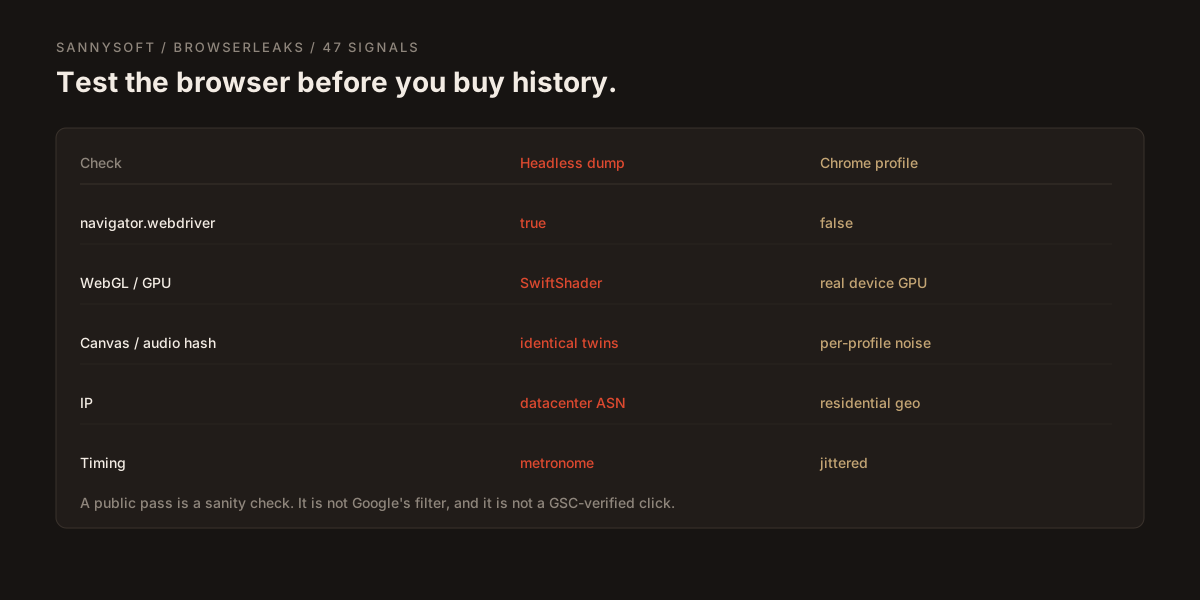
Bot Detection Software: What SEO Professionals Need to Know (2025)
Bot detection is why most CTR dashboards show clicks and rankings do not move. Google squashes fake browsers before NavBoost. Test fingerprints, IPs, and timing before you spend credits.
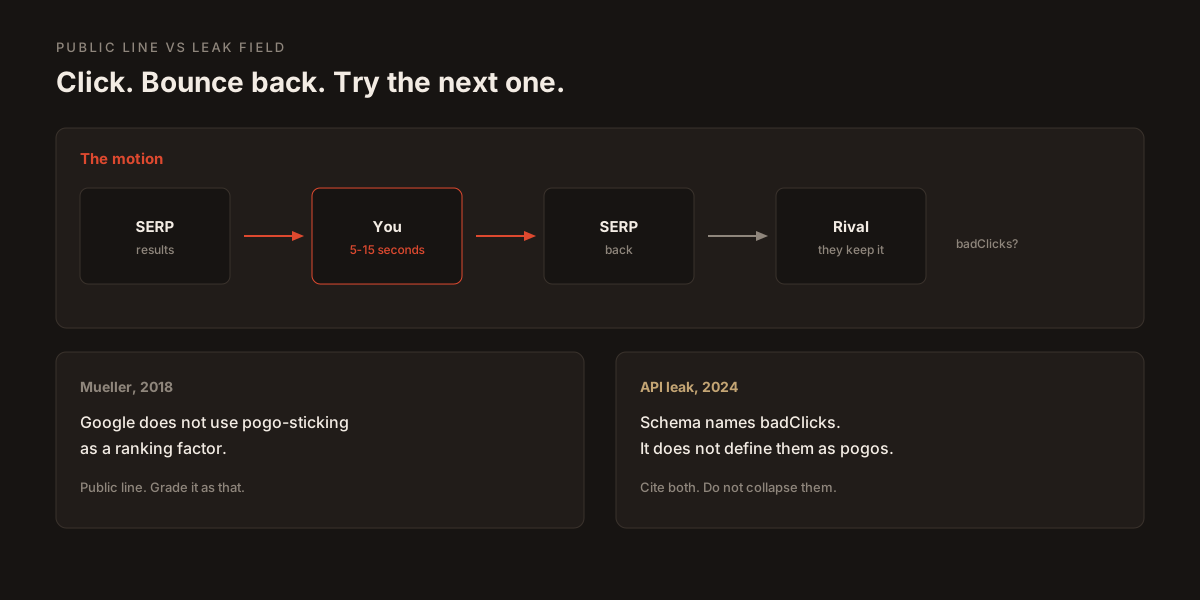
Pogo Sticking SEO: What It Is & Why It Kills Rankings (2025)
Pogo sticking is a quick return to the SERP after a click. NavBoost files that as a badClick. Here is how to spot it, what causes it, and how to keep dwell long enough that the back button stays unused.